The new era of going “Fast and Far” in research
A Nobel Prize in Chemistry went, in effect, to software. The old trade-off between small fast teams and large slow ones has stopped holding.
Small teams have always innovated. But AI means
a) We can split research into big and small teams
b) The small can do absolutely massive things now
In October 2024, a Nobel Prize in Chemistry went, in effect, to a piece of software. More precisely it went to the people who built it. Demis Hassabis and John Jumper at Google DeepMind took half the prize, sharing the rest with David Baker in Seattle. The thing they had made, AlphaFold, did in a few years what structural biology had been chipping away at for half a century. It predicted the three-dimensional shape of a protein from its amino acid sequence, and then it did it for almost every protein science had ever named. Around 200 million of them.
What really amazed me was the size of the project team. Just 19 names share the lead credit on the 2021 AlphaFold2 paper, the block marked as having contributed equally, and the full author list runs to thirty-three. This is a problem that had defeated the global biochemistry community for 50 years, only to be solved by an AI-enabled (and compute) small team.
Does this mean that the old adage, “If you want to go fast, go alone. If you want to go far, go together,” is no longer true in an AI-powered, agentic world? Usually attributed to West Africa, usually wheeled out to justify whatever the speaker had already decided to do. And for as long as I have been in research, it made sense. It described a genuine trade-off. You picked one. Speed or distance. The lone researcher sprints and burns out. The consortium endures and crawls. This is measurable. Lingfei Wu, Dashun Wang and James Evans went through more than 65 million papers, patents and software products spanning 60 years of output, and published the result in Nature in 2019. Large teams develop. Small teams disrupt. Small teams reach further back into older ideas, produce the more destabilising work, and pay off further into the future, if they pay off at all. Big teams take an existing line and push it forward. Go far, or go fast.
The trade-off breaks
The AlphaFold team was disruptive in exactly the Wu, Wang and Evans sense, reaching back to an old problem most people assumed was decades from solution. But it did not stay narrow, and it did not take a generation to land. Its predictions have since been used by more than two million researchers in 190 countries, and the core work was done inside about 18 months. Fast and far, from the same 19 people. AI is what collapsed it. A small team with enough model leverage now reaches as far as a consortium and keeps the speed of a startup. Go fast and far, alone. A lot of the data and models are open. Are we about to see a new class of small-team research disruptors?I pulled the author lists on the breakthroughs of the past three years where AI did the discovering, across several fields. The pattern holds.
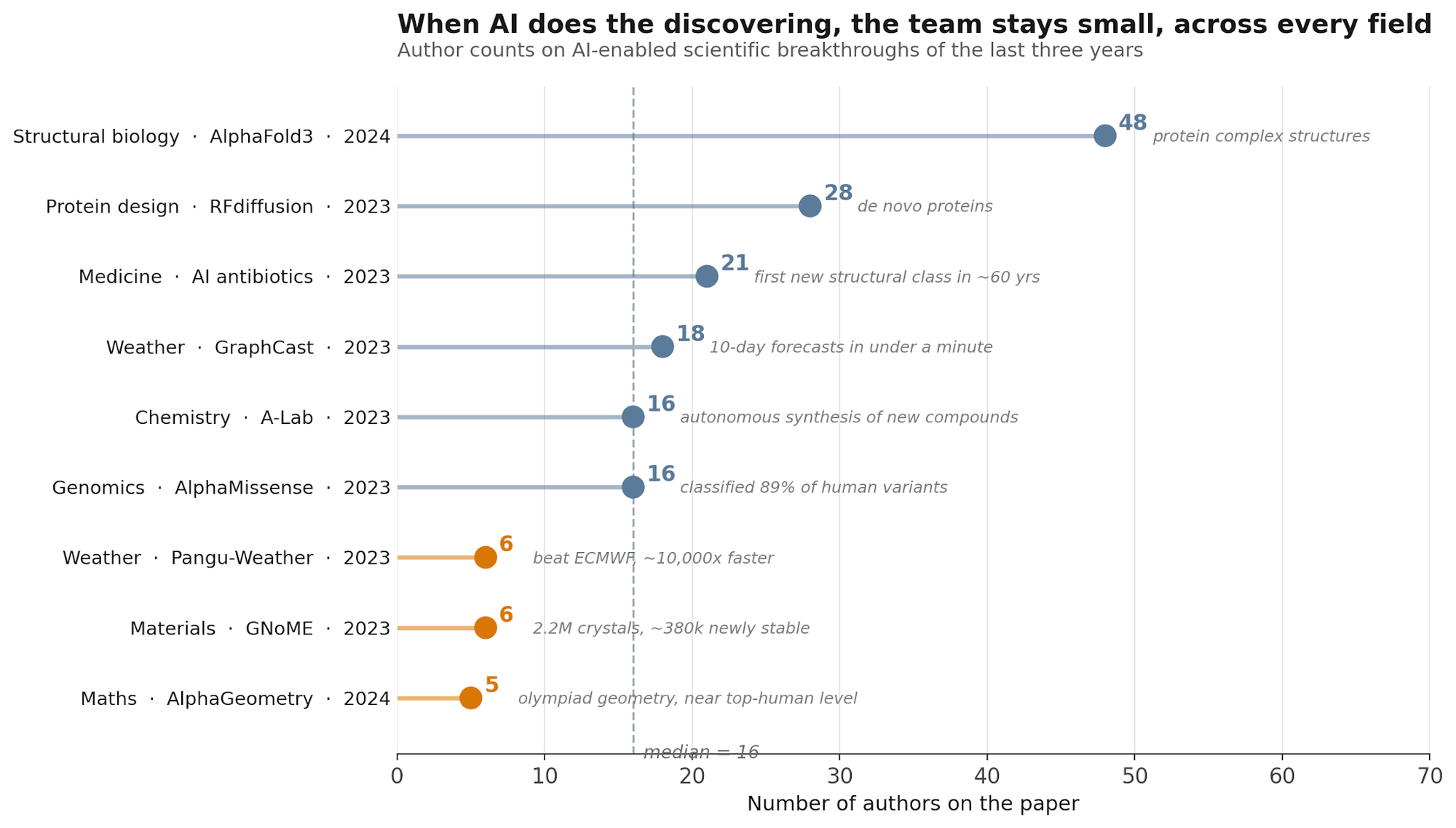
AI-enabled scientific breakthroughs of the past three years, by team size. Sources are Nature and Science. AlphaFold3, at 48, is the largest team in the set.
Six people built GNoME and predicted 2.2 million new crystals, around 380,000 of them stable, roughly a tenfold expansion in the stable inorganic materials known to science. Six more, at Huawei, built Pangu-Weather and beat the leading operational forecast. Sixteen built AlphaMissense and produced a verdict on 89 per cent of all possible human missense mutations, a resource clinical geneticists now draw on.
And before anyone objects that this is big tech doing it with pure compute, look at the wet-lab end. The new structural class of antibiotics that kills MRSA, the first new class in 60 years, came from screening more than 12 million compounds with a graph neural network and then synthesising the survivors and testing them in mice. Twenty-one people, across MIT, the Broad and two other institutes. Berkeley's A-Lab, a robotic chemistry lab that planned, ran and interpreted its own experiments to make dozens of new compounds, took 16. The two largest teams in the set are biology at the cutting edge, the Baker lab's protein design at 28 and AlphaFold3 at 48, and both are still small by the standards of the field they sit in.
So are these really small teams?
A short author list can hide a long shadow. Behind those six names on the Pangu-Weather paper sits Huawei Cloud. Behind AlphaFold sits the whole of DeepMind. And every one of these models learned from a dataset that took a large, slow, collaborative effort to build. So it's not like “six people did this alone”. It is “six people did this on top of what an institution spent decades assembling”. But either way, these small teams are doing in months what used to take a generation and a large workforce.
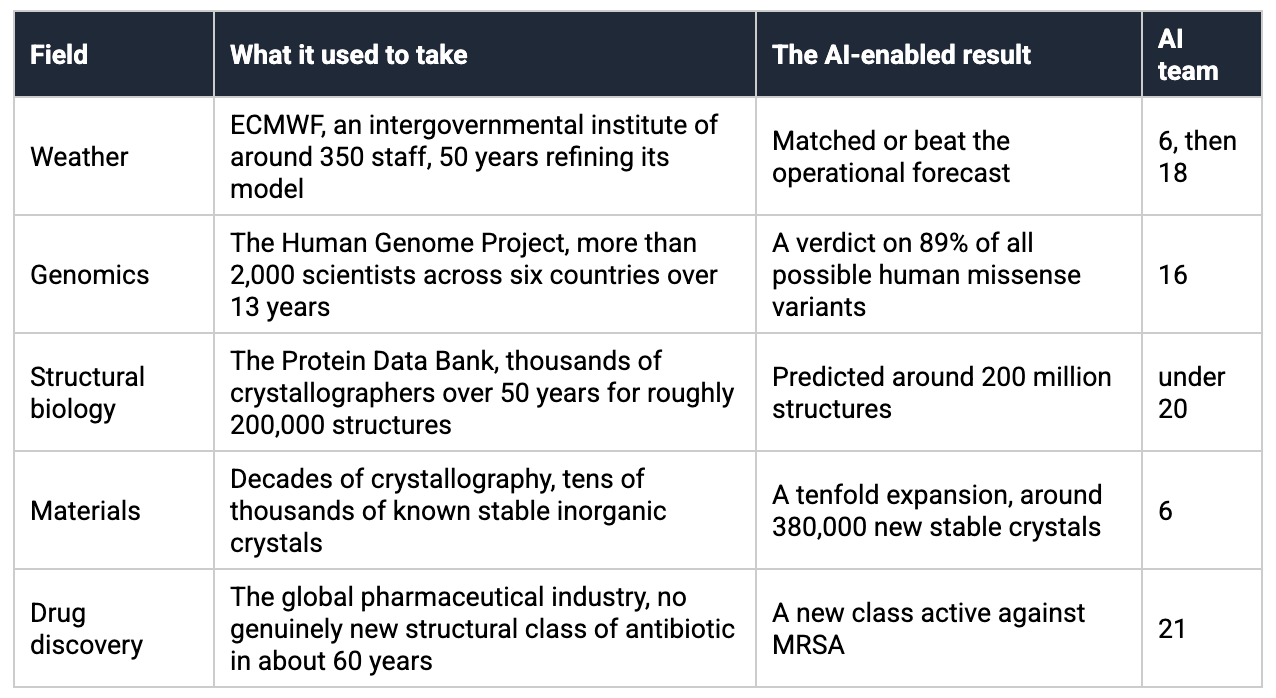
So both things are true at once. The teams really are small, and they really are doing what once took huge teams. The trick is that the huge team already ran. It built the substrate and left it in an open database where a handful of people with a good model could pick it up. Tier one takes an army and a decade. Tier two takes a dozen people and a few months.
Standing on the shoulders of giants
This is the bit that matters most if you care about research infrastructure.
AlphaFold did not arrive from nowhere. It learned to predict structures by training on the Protein Data Bank, which is to say it learned from 50 years of slow, expensive, collaborative experimental work. Every structure in that archive was solved by someone at a beamline or an NMR machine or a cryo-EM rig, then deposited, curated and shared. EMBL had been generating that ground truth for decades. Jumper has said it plainly: public data were essential.
So the small fast team did not replace the large slow collaboration. It stood on its shoulders. Once you see that, the two tiers stop looking like rivals and start looking like what they are, which is stacked. We’re seeing big philanthropic orgs picking up the heavy lifting when it comes to big data and models - biohub, Allen AI, Astera are all making massive amounts of information open to all. With folks predicting the third wave of American philanthropy, that AI will likely add ~$37–100B per year in intended philanthropic spend in the near future - the future for open science looks bright. It looks like the “go far, go together” side of things is taken care of.
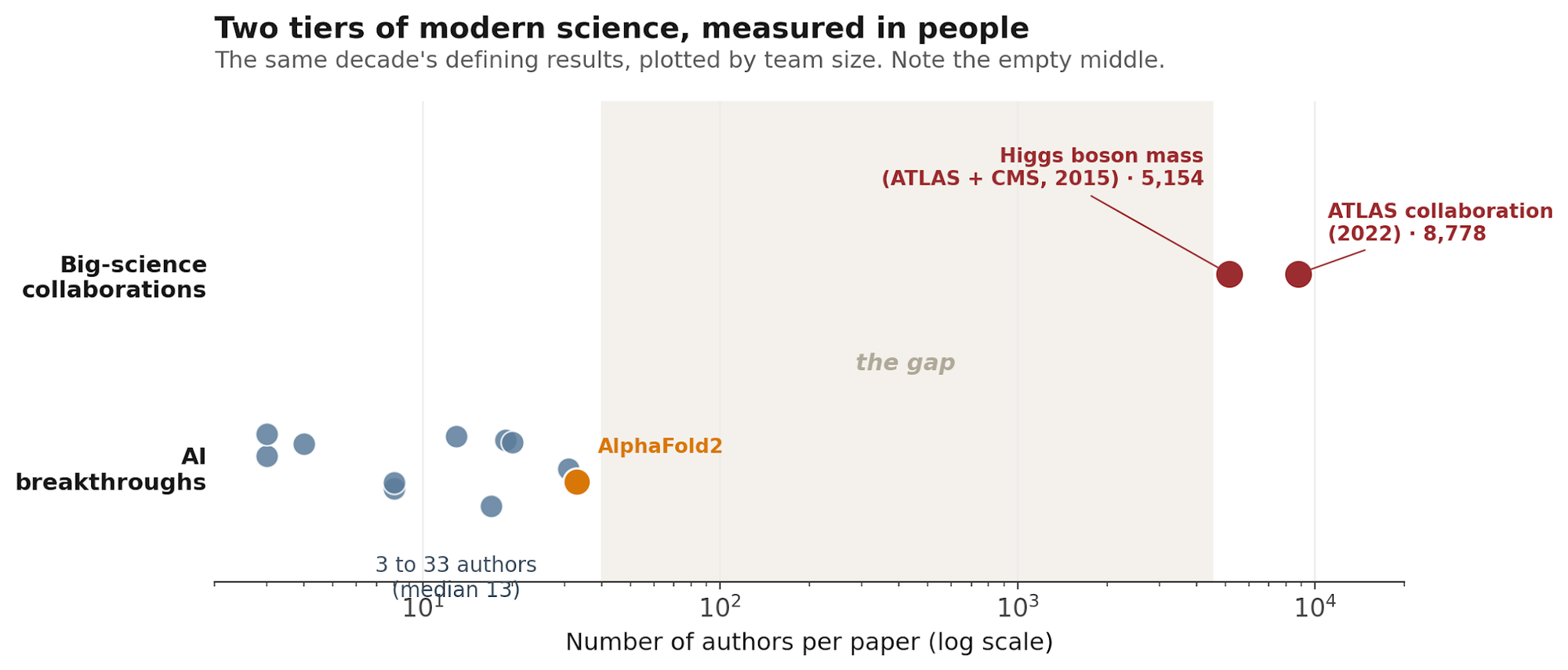
The same era's defining results, plotted by team size on a log scale. The Higgs boson mass paper carried 5,154 authors. A later ATLAS collaboration paper reached 8,778. The AI breakthroughs sit three orders of magnitude below, with almost nothing in between.
Two tiers, one stack
That gap in the middle of the chart is the story. Modern science is settling into two tiers. Tier one is the slow business of building the substrate: the atlases, the reference datasets, the standardised measurements no single lab could produce alone. It shows up in those author counts of five and eight thousand. It is how you measure a Higgs boson, and the most ambitious biological example of it now is the effort to model the cell. The Human Cell Atlas set out to catalogue every human cell type and had to invent the methods as it went. The Chan Zuckerberg Initiative has since put real weight behind a virtual cell, standing up one of the largest non profit GPU clusters in the life sciences, launching a Billion Cells Project with 10x Genomics and Ultima Genomics, and committing more than 10 billion dollars to basic research over a decade. The Arc Institute trained its first virtual cell model on more than 170 million cells. These are not papers. They are infrastructure, and they move at the pace of consortia.
Tier two is the small team with AI leverage. The PDB worked as a launchpad because it was open, it was standardised, it carried identifiers, and a machine could read it without a human in the loop. That is FAIR data doing the quiet work nobody hands out prizes for. Build the cell atlases of this decade to the same standard and they become launchpads too. Build them as a thousand incompatible spreadsheets behind a thousand logins and they don’t.
However small the team, you are still a team
Not one of those breakthroughs has a single author (yet). A team of 19 co-authoring a 60page paper with 32 component algorithms is not 19 people working alone. It is 19 people who have to think, write and ship as if they were one. A small team can go fast not because collaboration stopped mattering, but because its friction dropped close to zero. There is a reason why collaborative tools like Overleaf have 25 million users. Everyone writing together, in the same place, in real time, with the version history and the structure and the maths held in one place. Modern problems require modern solutions.
So I think the proverb needs a rewrite for the age of large models. If you want to go fast and far, go as a small team, give it real leverage, stand it on an open foundation someone else built, and give it tools that make collaboration close to effortless.