Whoever writes the paper, the tools have to be trustworthy
If we are going to hand more of the writing, the citing and eventually the analysis to machines, then the tools doing that work have to verify before they assert, keep provenance attached, and leave ownership with the human whose name is on the paper.
In the last post I argued that the paper might stop being the point, and that machine-generated, forkable research objects could change what a research output even is. That is the speculative end of my thinking and I stand by it. But there is a more immediate version of the same problem sitting on the desk of every researcher right now. Whether the next paper is written by a human, by a machine, or by the two of them arguing in the margins, the tools they use have to be trustworthy, reproducible, and they have to leave the work where it belongs, which is with the person who did it.
This week my colleagues at Digital Science launched Papers AI. One research workspace for your writing, your data and your code, with an assistant that has the whole project in context rather than the paragraph you happened to paste into a chat window. I will come back to what it does. First I want to make the argument for why the shape of the tool matters more than the feature list, because I do not think we are having that argument properly.
The board is visible in chess. It is not visible in a lab.
There is an essay from Thinking Machines, The Future Worth Building Is Human, that makes the following distinction. There are domains where raw intelligence really is sufficient on its own, and where AI can race ahead without anyone in the loop. Chess is one. Mathematics is increasingly another. What those two have in common is that the goal is static and can be written down, and there is no hidden knowledge. The board is visible to everyone. Nothing that matters is sitting in someone's head, unrecorded.
Research is not like that, and I think this is the thing that people building AI-for-science tools keep getting wrong. Most of what a lab knows is not in its papers. It is in the three approaches you already tried that did not work, which will never appear in any published record anywhere. It is in the reason you chose this cohort and not that one, and the argument you had with your collaborator about it. Michael Polanyi called this tacit knowledge, and Hayek's argument about why central planning fails is the same argument: the knowledge that matters is local, provisional, held privately by the people who acquired it through doing the work, and it does not survive being aggregated into one place. Life science researchers have an enormous context window.
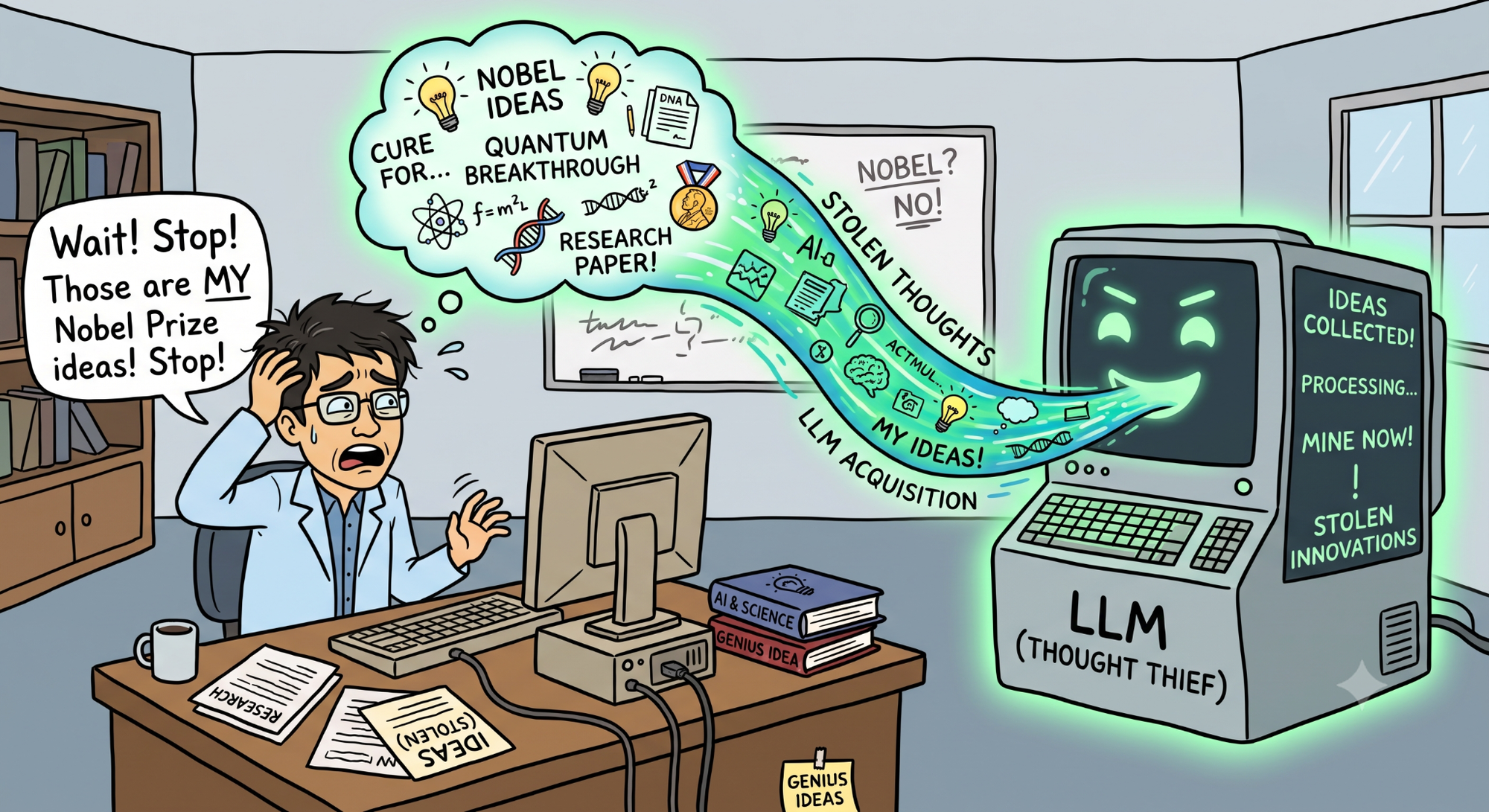
The warning Thinking Machines make is about AI that "extracts a snapshot of it and replaces it with a standard offering". Apply that to a manuscript in progress and it stops being abstract. A model reading your half-finished draft is not reading a paper. It is reading the tacit layer, the bit that never gets published, at exactly the moment it is most exposed and least protected.
Show me the incentives
Regular readers will know this is where I always end up, so let me apply it to the AI labs rather than to researchers for once. If your product is a single frontier model rented to millions, then every piece of specialised knowledge you can pull into the weights makes the product better for everyone else, and the researcher who supplied it has handed over the one thing that made them worth hiring.
Prism launched on 27 January, built on Crixet, a cloud LaTeX platform OpenAI acquired. Jonathan Schaeffer, emeritus AI professor at Alberta, made a useful split when he spoke to Decrypt: there are two things happening when you write a paper, composing the text and doing the actual research. Tools like this help with the former, the drafting and the proofreading and the literature search, and that is real and useful.
The problems are everything around the writing.
As Schaeffer put it. Standard protocol is that when you write a paper you are documenting your own research and you own it. Route that through a large multinational's model and, in his words, "you're actually exposing your intellectual property to a multinational company". Whether the provider would ever have a legal claim on what you produce inside their tool is, as he says, a question where the devil is in the details. By default, ChatGPT content, and therefore Prism content, may be used to train future models. Prism is now being folded into codex.
Who holds the line
I use frontier models a lot. I see it as a trade off between giving them my thoughts to train on and the incredible stuff I get back. I'm not an academic researcher and this may need more thought for them, because it is a decision about exactly where a line gets drawn across the research lifecycle, and the person drawing it is not the researcher. Drag the line below to see what I mean
The model reads the work before the researcher has published it.
Private to the researcher Read by the model
Drag the line, tap a stage, or use the arrow keys
The point of it is not that one of those three stages is objectively correct. I have my view, which is that the second one is where the trade-off is least bad, but I know serious people who would put it at the third and have good reasons.
Wherever the line goes, it should be the researcher who puts it there. Not a vendor, not a default, not a setting three menus deep that got flipped during an update you did not read. If a researcher decides their unpublished analysis is not ready for a model to learn from, that decision has to be enforceable, not merely requested.
Almost every tool in this space puts the line at stage one.
Papers AI moves the line into the architecture
Which brings me back to Papers AI, and to why I think its shape matters more than its feature list.
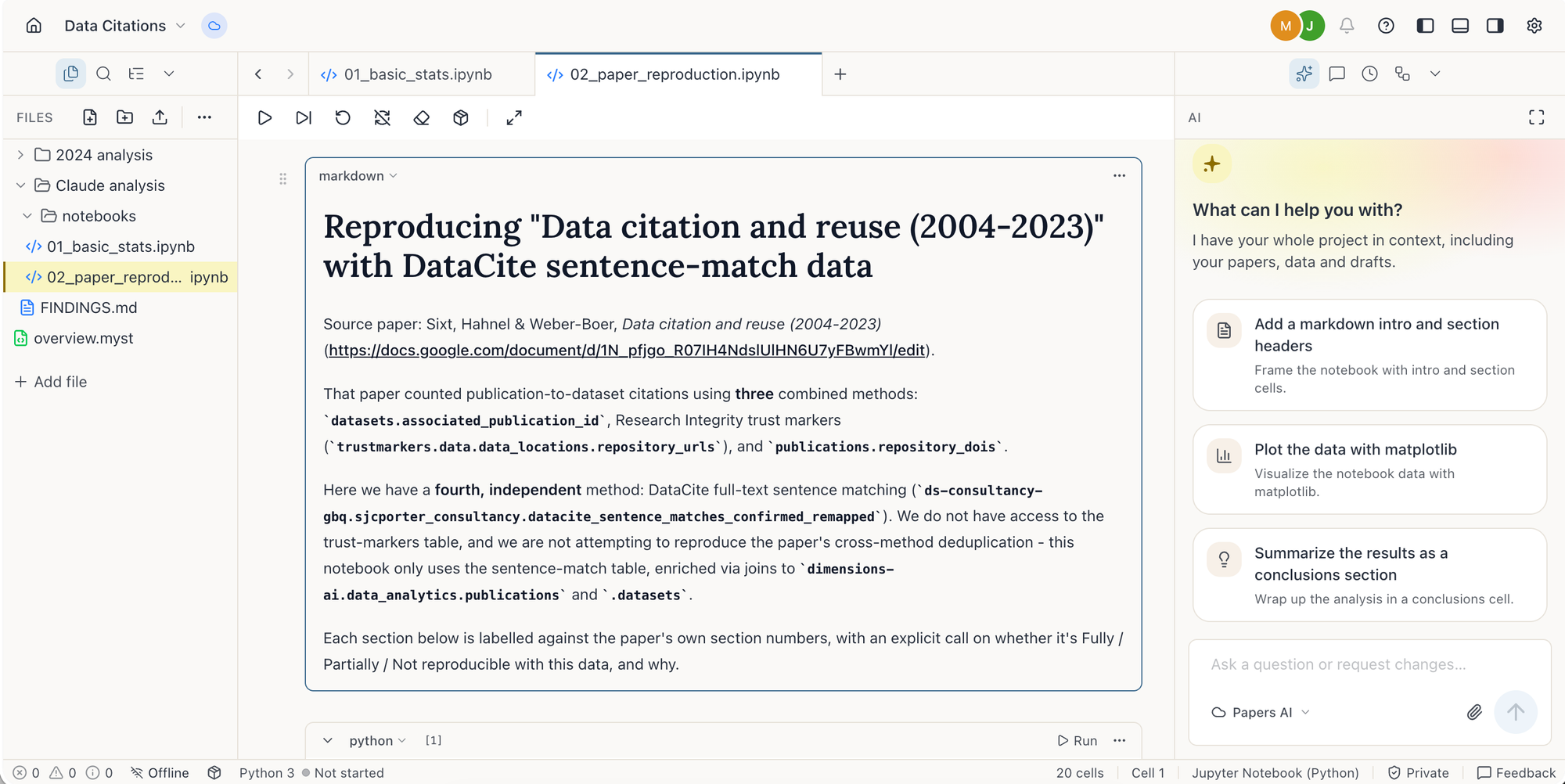
You can write in Word, LaTeX, Markdown or Typst. Real .docx with tracked changes and comments that survive conversion, which anyone who has collaborated across a Word-and-LaTeX divide will tell you is not a small thing. Your datasets and Jupyter notebooks live in the same project as the draft, so the analysis and the prose stop drifting apart. A reviewer asks you to re-run something, you update the cell, and the figure regenerates where the manuscript already is.
The assistant reads the whole project, and pulls citations from your own reference library, verifying them before insertion. Every change it makes appears as a reviewable diff. You accept or reject. The assistant's edits are attributed and reversible, the same as a human collaborator's.
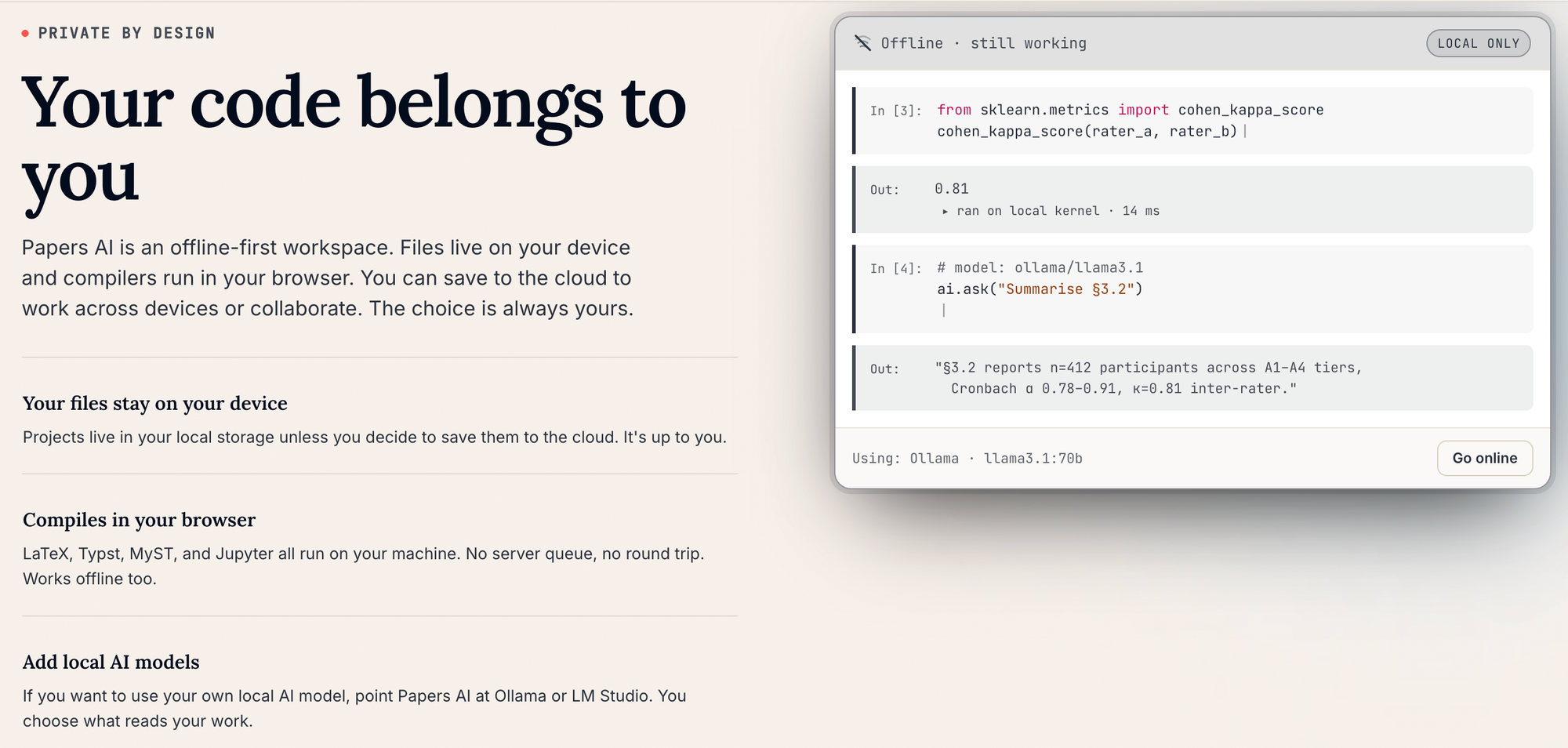
And you can bring your own model. Use the built-in assistant, or point it at something local running on Ollama or LM Studio or any OpenAI-compatible endpoint. Files stay on your device. Compilers run in your browser. Collaboration happens when you invite it, project by project.
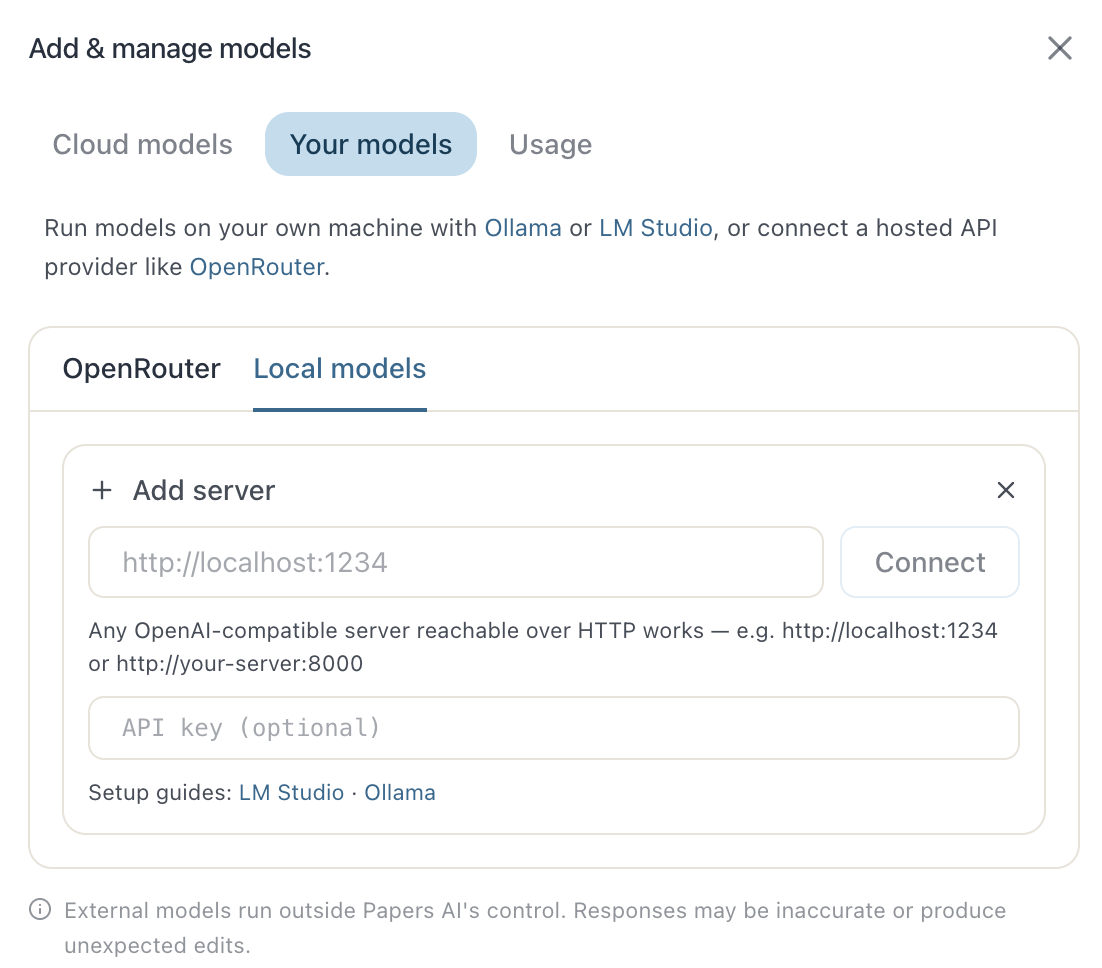
That last part is usually written up as a privacy feature. I think it is better understood as the answer to the question the slider asks.
Point the assistant at a model running on your own hardware and the embargo line stops being a policy and becomes a fact about where the electricity is going. Nothing has to be promised, because nothing left. Keep the files on the device and the compilers in the browser and the line holds even if every term of service on earth changes tomorrow. If the risk is that a centralised model absorbs what makes your lab distinctive, the mitigation is not a stronger assurance from the provider. It is not having sent it. You cannot extract a snapshot of a lab's tacit knowledge from a model that never left the building.
Local inference is not exotic in 2026, and anyone could build this way. Building the version where the researcher keeps the line is a decision about who the tool is for, and it is the decision I would want made by whoever I trusted with an unpublished manuscript.
We ran a webinar on exactly this last week, AI Uncorked: guardrails, compliance and IP protection for the enterprise, with John Lees-Miller, who co-created Overleaf, alongside Mark Bloomfield and the ECB's Maximilian Freier. The whole conversation was about the question underneath all of this. Not whether to adopt AI in research, because that ship has sailed, but how to do it without putting sensitive data, proprietary research and IP at risk. How to build guardrails so teams can use these tools with confidence. How to make sure that the research which is yours, stays yours.
In the last piece I got excited about a future where research outputs are forkable, verifiable, machine-readable objects that people and agents can build on at speed. I still want that future. But a forkable research object is only as trustworthy as the tools that generated it and the tools that check it. Reproducibility is not a nice-to-have bolted on at the end, it is the substrate. And if we are going to hand more of the writing, the citing and eventually the analysis to machines, then the tools doing that work have to verify before they assert, keep provenance attached, and leave ownership with the human whose name is on the paper.
In chess, intelligence alone gets you all the way, because there is nothing hidden. Life science research is not chess (yet). Maths and Physics will be solved long before wet lab research. Most of what a lab knows was never written down, and the tools we adopt now will decide whether that knowledge gets cultivated where it is, or quietly extracted and sold back to us as a standard offering. Whoever ends up writing the papers, humans, machines, or both, they need better tools and Papers AI is one of them.