What's so wrong with everyone and anyone publishing "research"?
We need to make the status of every contribution visible and portable, reward the replication, correction and synthesis that make other work dependable, and let AI help authors check before they ask the rest of us to.
A year ago I wrote Academia has a new preprints problem, worried about chatbot conversations being dressed up as papers and dropped into research repositories. The pressure has not gone away. On 1 October 2026, arXiv capped every submitter at two new submissions per calendar month, calling it a stopgap while its moderation adapts. We see the same thing at Figshare. But "the infrastructure can't cope" is not the same as "more publishing is bad". The problem is, if everyone can publish, who does the checking and what knock on consequences will there be in establishing facts from opinions?
What is actually wrong with everyone publishing whatever they want as research? If someone spends a weekend talking to a frontier model and emerges with an interesting theory, why shouldn’t they share it? Perhaps it is wrong. Perhaps it has already been proposed. Perhaps the author has misunderstood something fundamental. Perhaps the author doesn't understand the research at all. None of those possibilities is unique to people using chatbots. We need to explain what the harm actually is.
There is a serious case for publishing more
The argument for openness in research is straightforward. More people can explore more questions. Someone outside a university might notice something people inside it have missed. A useful connection might emerge between fields whose researchers rarely speak to each other. The idea of gatekeeping “who” can publish “research” is becoming much more nuanced. I am against a system in which your right to contribute depended on already belonging to the right institution. As we’re seeing with Maths, an extremely valuable insight doesn't necessarily take years to produce. If someone finds a correct, useful result in an afternoon, the appropriate response is to examine it. There are already other examples of LLM-based systems contributing to discovery. FunSearch combined a language model with a systematic evaluator and found new mathematical constructions that improved on previous results. Generating candidates became productive because the system could check them and build on the successful ones.
I also don't know if the signal-to-noise ratio matters if volume is growing exponentially. Imagine 1,000 papers containing 100 useful contributions. Now imagine 100,000 papers containing 1,000 useful contributions. The proportion of useful work has collapsed, but the amount of useful work has increased tenfold.
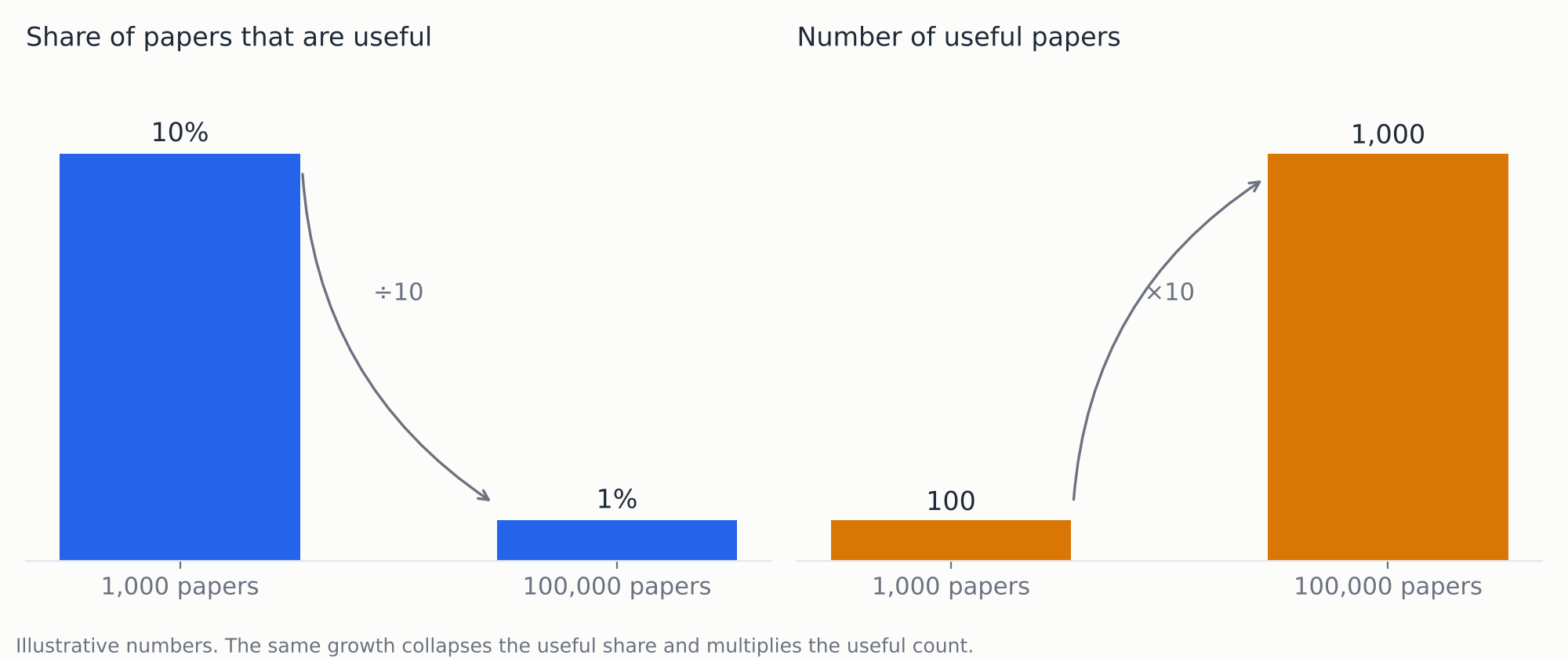
Figure 1. A thought experiment with illustrative numbers. Whether those 1,000 contributions can be found and developed at reasonable cost is a separate question.
Publishing far more ideas could accelerate science. The complications start when we ask how those ideas become usable knowledge.
The pile is growing faster than it used to
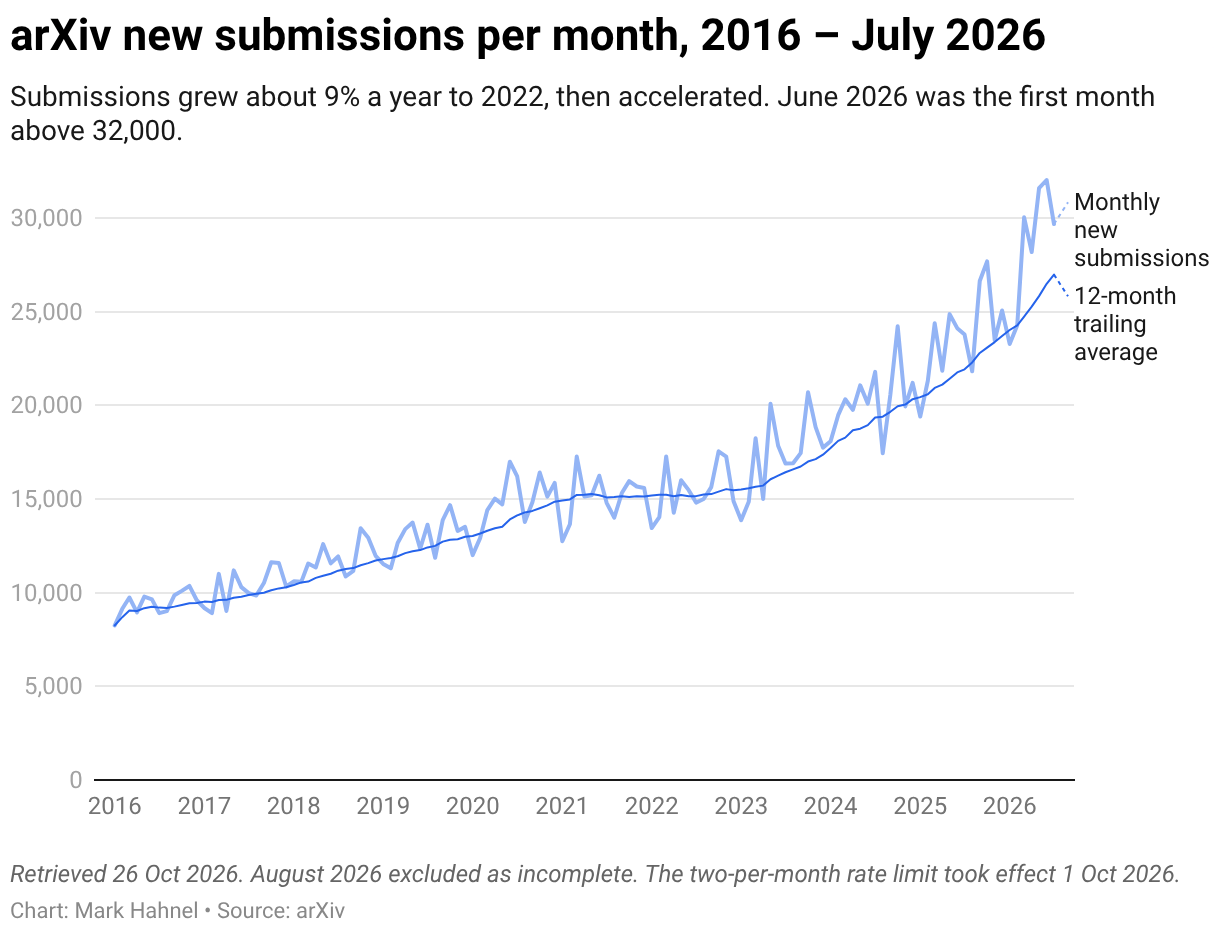
arXiv received 113,380 new submissions in 2016 and 284,486 in 2025. The first seven months of 2026 brought 199,149, up 25% on the same months of 2025. June 2026 was the first month ever above 32,000.
Interactive version: https://datawrapper.dwcdn.net/Fmqee/1/
Figure 2. arXiv new submissions per month, 2016 to July 2026. Source: arxiv.org/stats, retrieved 26 October 2026. August 2026 is excluded as incomplete.
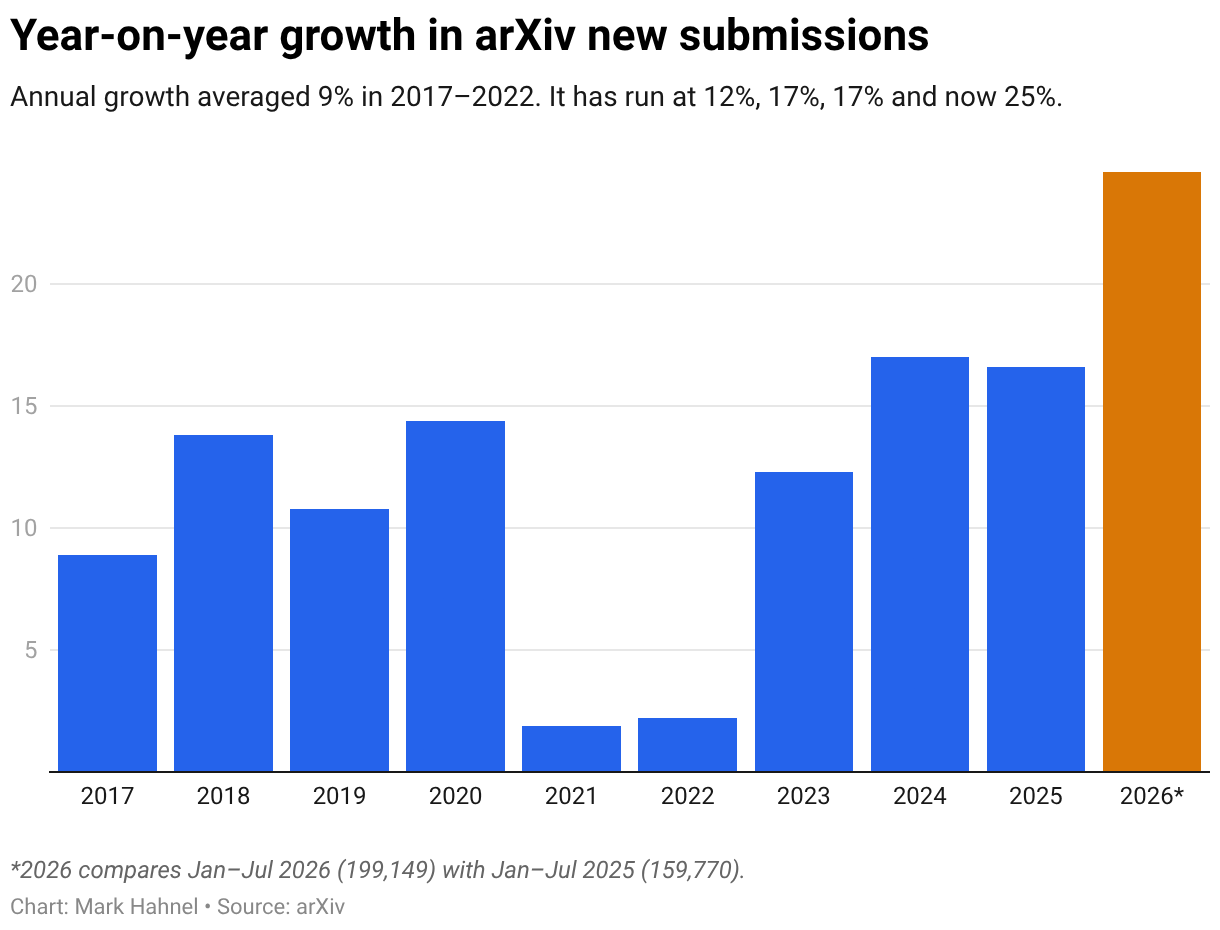
Growth is not new; arXiv grew about 9% a year through 2017 to 2022. What changed is the rate. From 2023 the annual increase has run at 12%, 17%, 17% and now 25%. This is an operational problem, and that is the problem the rate limit addresses. It does not tell us whether the extra 40,000 papers a year are useful.
Interactive version: https://datawrapper.dwcdn.net/G2dJu/2/
Figure 3. Year-on-year growth in arXiv new submissions. 2026 compares January to July with the same months of 2025.
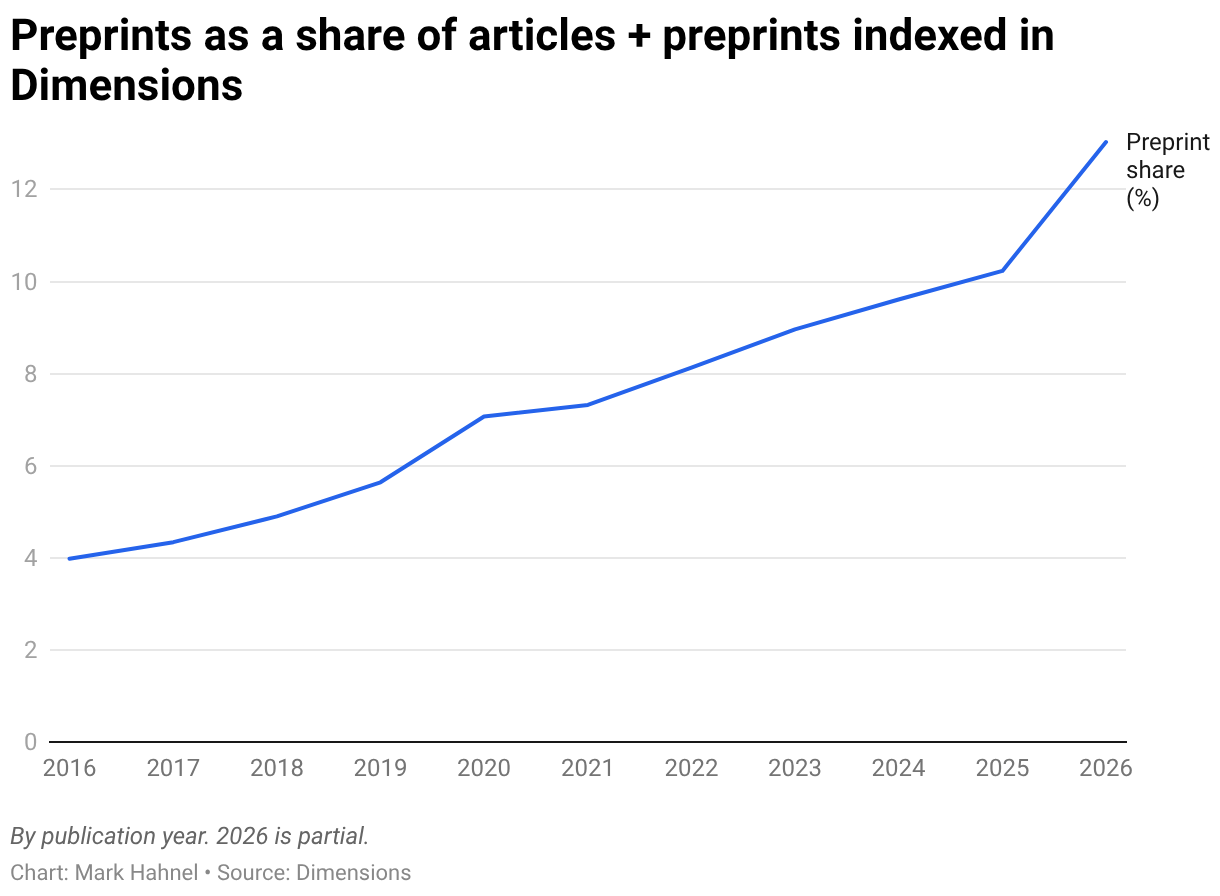
arXiv is one server, so I also checked Dimensions.ai, which indexes preprints from all of them. There were 154,279 in 2016 and 770,405 in 2025, when preprints made up 10.2% of everything it indexed as an article or preprint, up from 4.0%.
Interactive version: https://datawrapper.dwcdn.net/A97xn/1/
Figure 3b. Preprints as a share of articles and preprints indexed in Dimensions, 2016–2026. Source: Dimensions, retrieved 26 October 2026. 2026 is partial.
The cost of a publication becomes cheap because someone else does the work
Suppose I generate a convincing paper about a new theory of gravity. I have checked that it reads well, but I cannot independently assess the mathematics (I am neither a mathematician nor physicist). I upload it and invite physicists to tell me whether I have discovered something. This is a request for work.
Someone has to establish whether the argument is coherent, whether it contradicts known observations, whether the references support it and whether the contribution is new. That will take considerably longer than producing the manuscript.
Asking for help is a normal part of research. The difficulty comes when I can generate another twenty papers before anyone has finished examining the first. The curation/review cost has not disappeared, it has been passed to other people. An unread PDF sitting on an obscure website may cause very little trouble. The costs become more substantial when that PDF enters moderation queues, literature searches or somebody’s attempt to understand a field. It also competes for the attention needed to examine other work. This is the strongest objection to publishing indiscriminately - authors can receive the benefits of making claims while transferring most of the cost of assessing them to the community.
What if AI makes checking cheaper too?
If AI makes papers cheaper to produce, it should make them cheaper to assess. Lionel Page argues that technical feedback could become fast, cheap and part of writing itself, and less biased than human review. He is right that we should not assume generation keeps improving while checking stays fixed. In August 2026 the American Economic Association partnered with Refine for technical checks on papers near a revise-and-resubmit decision, explicitly separating those checks from judging importance and from mass screening. More recently Google released Deep Review, originally built to deal with the massive influx of conference submissions at computer science conferences “there were over 74,000 submissions to three major AI conferences (ICLR, NeurIPS, and ICML) up from approximately 45,000 in 2025, 32,000 in 2024, and 23,000 in 2023.” It was then announced that Springer Nature and Google DeepMind collaborate to enhance the peer review experience.
Where reliable evaluation becomes cheap, abundant generation becomes attractive. Where a claim needs a new experiment or years of observation, humans are needed in the loop.
Repetition can start to look like evidence
Now imagine a speculative claim gets repeated. Other authors use similar models, or cite the preprint, or an AI research assistant summarises the surrounding literature and reports that "several studies have suggested this mechanism". At each step the claim looks more established, though nobody has gathered any new evidence for it.
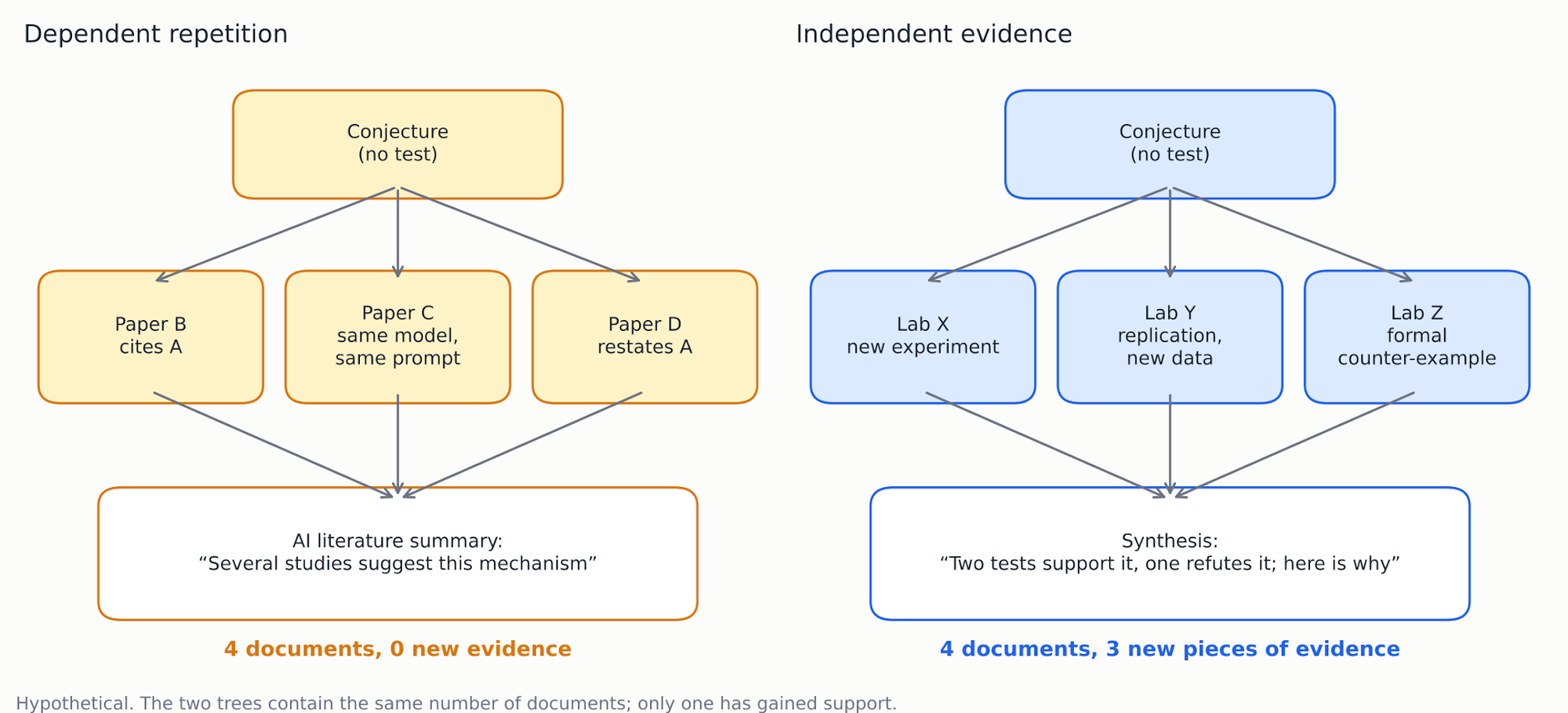
Figure 4. Hypothetical. Both trees hold four documents. Only the right-hand one has gained any evidence, and only the right-hand explains the provenance.
This is different from information overload. A hundred independent observations support a claim, a hundred documents repeating one conjecture do not. What matters is the provenance and dependencies. Where did the claim originate, which papers tested it, which share the same data? Unreliable material is already entering those dependencies. A May 2026 audit of 111 million references across 2.5 million papers estimated around 147,000 nonexistent citations in 2025 and associated the rise with LLM adoption. Anything downstream that trusts it carries the error further.
We could reward the wrong activity even more efficiently
I could publish ten proposed mechanisms. Someone else spends a year testing one and finds it does not work. If productivity means counting papers, I look more productive, and everyone has an incentive to keep proposing and leave the testing to somebody else. Cheap generation makes it easier to split small results across many papers. There have been many examples of researchers getting paid bonuses by their institution or funder for publication. The incentives soon lead to the expected problematic outcomes. Continuing to do this will risk making what is now the least expensive part of research the most rewarded.
Automated review adds a second incentive to watch. A June 2026 preprint raised scores from three AI reviewers by changing presentation alone, with methods, experiments and numbers held fixed. Page expects reputational concern to discourage gaming, and for most researchers it will. But a system open to everyone includes people with no professional reputation to lose.
Maybe speculation needs its own shelf
So why don't we give speculative work somewhere to live that is deliberately outside the research record. A venue with different rules and different expectations:
- Contributions are labelled by what supports them: conjecture, model-generated synthesis, untested proposal, thought experiment. The label is machine-readable and travels with the item into search results, alerts and summaries.
- Nothing there is cited as evidence. Indexes, citation databases and literature tools treat it the way they treat a blog post or a talk. That is discoverable, attributable, linkable, but never counted as a study.
- Promotion is explicit. When someone tests a conjecture, the test is published in the research record with a link back, and the original item gains a visible status: supported, refuted, superseded. The dependency structure in Figure 4 becomes something readers can see rather than infer.
- Authors keep priority and credit for the idea, and the people who test or refute it get credit for that, which is the credit our current system struggles to assign.
But then again, who would post there, when the research record offers more prestige for the same PDF? If the only reason to format a conjecture as a paper is that papers get taken more seriously, we have an incentive problem, not a moderation problem, and no rate limit will fix it. A separate shelf would let repositories keep their doors wide open for research while giving the "I asked a model and got something interesting" genre an honest home. It would not require anyone to decide whether a model can have an original idea. It would only require the author to say what they did.
Interactive · illustrative model
Who checks the pile?
Each dot is 200 papers. Writing them is getting cheap. Checking them isn't.
- 0Waiting to be checked
- 0Useful papers buried in the pile
- 0Useful papers found
- 0Citations resting on unchecked claims
- 0Labelled conjectures on the shelf
Illustrative model, not data. Useful papers grow as √(10 × volume), so 1,000 papers hold 100 useful ones and 100,000 hold 1,000 (Figure 1). Checkers handle 3,000 papers a month, or four times that with AI technical checks. Mark Hahnel
Keeping the door open
We need to make the status of every contribution visible and portable, reward the replication, correction and synthesis that make other work dependable, and let AI help authors check before they ask the rest of us to.
We need accountability and reciprocity. If I want the research community to spend time on my claim, it is fair to ask what I have done to make that time worthwhile.